
Choosing home internet in Columbus comes down to the exact block. One street gets fiber, the next falls back to cable, and a full-bar 5G icon still may not open a Home Internet slot. On August 4, 2026, we pulled every Broadband Facts label, speed test and price sheet, then ranked the city’s five major networks by speed, 36-month cost, reliability, coverage and perks. In short: WOW! reaches the most homes for the lowest price, AT&T Fiber owns the latency crown, Mediacom’s new 2-Gig tier shakes up cable, and fixed-wireless fills gaps where wires stop. Grab your address – we’ll help you pick the right line.
1. WOW! : best overall internet provider in Columbus
Why WOW! ranks first
WOW! reaches 90 percent of Columbus addresses and sells its 300 Mbps tier for $25 a month. That near-universal footprint plus budget pricing makes it the easiest “just work” choice for most homes.
Because plans change block by block, run the official Columbus Georgia ultra-fast internet checker to see the Broadband Facts label for your exact address.
The HFC network tops out at 1.2 Gbps down / 50 Mbps up, enough for 4K streaming, cloud backups and online gaming, with WOW’s own residential measurements putting access latency around 21 ms in the evening window. Every tier includes a gateway, unlimited data, a 30-day money-back guarantee, and no annual contract, so you can upgrade or cancel without penalties.
Value continues after month one. For $5 a month, WOW!’s optional Price Lock for Life freezes your base rate as long as you keep the same speed. Add broad self-install eligibility and optional eero-based security and mesh, and WOW! covers more daily needs than any rival at this price.
2. AT&T Fiber: best for gaming, uploads, and remote work
Why AT&T Fiber is the technical winner
If low ping matters more than low price, start with AT&T Fiber. This 100 percent fiber-to-the-home line delivers symmetrical speeds up to 5 Gbps and a provider-reported ≈10 ms median access latency, according to AT&T’s performance disclosure. No local cable plan matches that pair. For gamers, livestreamers, and cloud workers, you get faster updates, smoother broadcasts, and quicker backups without slowing the rest of the household.
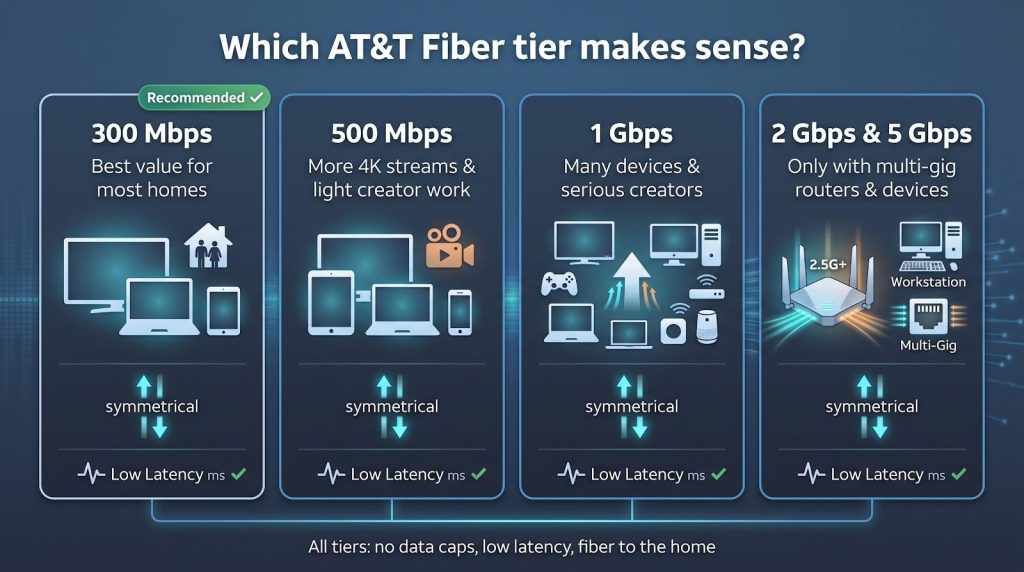
Which tier makes sense
- 300 Mbps – best value for most homes.
- 500 Mbps or 1 Gbps – multiple 4K streams or a serious content-creator roommate.
- 2 Gbps and 5 Gbps – only if you own multi-gig routers (2.5 GbE+) and devices that can draw more than a gig.
Pricing, fees, and the fine print
AT&T lists Internet 300 at $35 a month with AutoPay. After the 12-month promo, the Broadband Facts label shows about $60–$65 a month. A new install can cost up to $99 and take three to four hours while techs pull fiber and mount an ONT. Every plan includes a Wi-Fi 6 gateway, no data cap or contract, and ActiveArmor security. Need Wi-Fi 7? The All-Fi Pro mesh costs $25 a month on lower tiers and is included on 2 Gig and 5 Gig.
Availability cautions
Independent coverage data puts Columbus FTTH reach near 39 percent, but block-level access varies, so run AT&T’s checker and confirm the word “Fiber” appears in the plan list.
Pros and cons snapshot
Pros
- Lowest documented latency in Columbus
- Symmetrical uploads through 5 Gbps
- No caps, contracts, or modem fees
Cons
- Spotty neighborhood availability
- Price rises after year one
- Install requires time and a clear fiber path
If your address qualifies, AT&T Fiber is the fastest, most responsive line in town. If it doesn’t, the next sections outline strong cable and fixed-wireless options.
3. Mediacom Xtream: best multi-year cable deal
Why Mediacom has improved since older rankings
Mediacom carried a data-cap warning for years, but that label expired on June 10, 2026 when the company launched 2-Gig service across its entire footprint and removed downstream caps on new plans, according to a June 2026 Mediacom press release. Columbus coverage now sits at ≈80 percent (79.7 percent per InMyArea), turning what was once a last-resort option into a solid pick for most neighborhoods.
The upgrade delivers more than raw speed. Current plans lock promo rates for two years on 300 Mbps and three years on 1 Gig or 2 Gig, so your bill stays predictable well beyond the usual 12-month discount. Each tier ships with an eero mesh system (eero 6 on 300 Mbps, eero 7 on Gig and 2 Gig). Uploads are the limit rather than the selling point: Mediacom publishes up to 20 Mbps on Internet 300 and up to 50 Mbps on both Gig tiers, so the 2-Gig plan buys you download headroom, not upstream. The only other asterisk is a 1 TB monthly upstream threshold. Exceed it, and Mediacom can cut your upload speed by half for the rest of the cycle.
Together, these shifts make Mediacom one of the few cable providers that rewards staying put instead of pushing you to switch after year one.
4. Spectrum: best no-cap cable alternative
Where Spectrum shines
Spectrum keeps the offer simple: no data caps, no annual contract, and a free DOCSIS modem on every tier. Plans start at 100 Mbps for $30, rise to 500 Mbps for $40 when you order online, and top out at 1 Gbps for $60 during the first 12 months. Unlimited data means you can binge, game, and download without watching a meter.
Pricing reality after year one
Month 13 is the catch: the FCC Broadband Label for Internet Gig lists a $105 standard price. Over 36 months, that total can outrun WOW!’s lifetime lock or Mediacom’s three-year promo, especially on the 100 and 500 Mbps tiers that add a $10 Advanced Wi-Fi fee.
Speed and gaming caveats
Download speeds match rival cable offers, but uploads top out at 35 Mbps on Gig. That is fine for Zoom, yet tight for large video pushes. Since Spectrum’s HFC network is shared, a congested node can spike evening ping while a neighbor’s fiber line stays flat.
Availability and local sentiment
InMyArea’s July 2026 data shows Spectrum at ≈40 percent Columbus coverage, concentrated in older neighborhoods and many apartments. Reviews are mixed: some streets report solid uptime, others see buffer wheels at night. Use the 15-day self-install window to test before canceling an existing line.
Quick pros and cons
Pros
- Unlimited data on all tiers
- Straightforward month-to-month terms
- Wi-Fi 7 gateway included on Gig
Cons
- Big price jump after 12 months
- 35 Mbps upload limits creators
- Performance changes with node health
Spectrum fits when you need a contract-free, unlimited line and fiber is not on your block. Just add the post-promo price to your budget so next year’s bill does not surprise you.
5. T-Mobile 5G Home Internet: best for renters and easy setup
Why T-Mobile makes the list
Unbox the cellular gateway, plug it in, and you are online in about 15 minutes. No coax, trench, or fiber splice is required. That low-friction install is ideal for renters, students, or anyone stuck waiting on a cable appointment.
Coverage versus capacity
A phone’s 5G icon does not guarantee Home Internet. T-Mobile limits fixed-wireless slots per tower so mobile handsets keep priority. InMyArea’s July 2026 data shows service orderable at ≈44 percent of Columbus addresses. Check the availability tool, and check again later as tower capacity shifts.
Performance realities
Columbus users typically see 100–300 Mbps down, with lucky towers peaking near 500 Mbps; heavy congestion can drop below 50 Mbps. Latency sits near 40 ms at noon, then can climb past 80 ms in the evening as traffic is deprioritized behind phones. Casual Zoom works fine, but competitive shooters and large cloud backups still prefer a wired fallback.
Pricing, trial, and fees
- $50 a month with AutoPay, taxes included, and T-Mobile’s 5-Year Price Guarantee holds that base rate for five years.
- One-time $35 device connection charge due at sale.
- 15-day Test Drive: cancel within 15 days of activation and submit your redemption within 30 days of cancelling to get service charges back.
Pros and cons snapshot
Pros
- Fast DIY setup, no landlord drilling
- Flat $50 bill with a five-year price guarantee
- Works when buildings block new cable runs
Cons
- Evening speeds and ping vary with tower load
- Eligibility tied to tower capacity, not signal strength
- CGNAT can complicate hosting game servers or remote-access tools
T-Mobile 5G Home is the easiest broadband to start and stop in Columbus, making it perfect for short-term housing or as a backup to a wired line that sometimes flakes out.
Other Columbus internet options worth checking
Starlink (rural fallback)
Starlink covers nearly every rooftop around Columbus, yet hardware costs several hundred dollars up front and service runs over $100 a month, which makes it a last resort inside the city. Starlink advertises up to 375+ Mbps on its current hardware, while typical observed speeds land between 60 and 220 Mbps with 60–80 ms latency, and you need a clear southern sky plus roof clearance.
Small fiber builds
Check the FCC National Broadband Map for pockets served by Conexon Connect or other co-op fiber networks, especially on the northern edge of Muscogee County. Coverage is usually well under 5 percent, but where it exists you may find true gigabit service at competitive long-term prices.
T-Mobile Fiber (watchlist)
Bright-pink splice trucks and a handful of speed tests suggest symmetrical 1–2 Gbps fiber is quietly rolling into parts of Columbus, yet as of August 4, 2026 T-Mobile has not released an official address checker or Broadband Facts label for the service. Without those documents we cannot confirm coverage, long-term pricing, or whether residential lines get public IPv4 addresses instead of CGNAT.
If a door hanger lands on your porch, or you spot crews running new fiber, bookmark any new checker the carrier launches and enter your address. A competitively priced 2 Gig plan could reorder next year’s rankings, but until hard data appears, T-Mobile Fiber stays on the watchlist, not the scorecard.
Verizon 5G Home (plan B when T-Mobile is full)
Verizon’s fixed-wireless line looks similar to T-Mobile’s: plug in a cellular gateway, skip drilling and contracts, and pay a flat rate.
In Columbus, Allconnect estimates Verizon Home Internet is orderable at ≈37 percent of addresses. With an eligible Verizon mobile plan and Auto Pay, 5G Home starts at $35 per month; without the bundle it is $60 per month.
Speeds usually land in the 100–300 Mbps band, with rare 1 Gbps peaks on downtown millimeter-wave blocks. Congestion and CGNAT still apply, so gamers should test ping, NAT type, and party chat during Verizon’s 30-day money-back window.
Choose Verizon 5G Home when you:
- Cannot get wired service, or T-Mobile has no tower capacity.
- Already carry an unlimited Verizon phone plan and want the $35 bundle rate.
- Need a contract-free backup you can pause without early-termination fees.
Skip it when a solid wired line, or AT&T Fiber, reaches your door; once the mobile discount disappears, cable or fiber often wins on price-to-performance.
Which Columbus ISP is best for gaming?
First-hop latency snapshot
| Provider | Reported median access latency* | Source | Notes |
| AT&T Fiber | ≈10–11 ms | AT&T performance disclosure | Symmetrical FTTH |
| WOW! (cable) | ≈21 ms on 300 Mbps tier | WOW! network-management PDF, residential metrics | HFC; node load varies |
| Mediacom 2 Gig (10G areas) | ≈23 ms | Mediacom broadband disclosure (2026) | Uploads up to 50 Mbps |
| Legacy Mediacom / Spectrum (HFC) | 25–33 ms | Citywide HFC averages | Shared-node cable |
| T-Mobile 5G Home | 40 ms at noon, then 80 ms peak | T-Mobile Home FAQ on deprioritization | Traffic lower priority than phones |
| Verizon 5G Home | 30–80 ms | User-reported tests; no local label | mmWave can drop below 30 ms downtown |
*Access latency measures the first hop from your router to the ISP hand-off, not the total game-server ping.
What the numbers mean
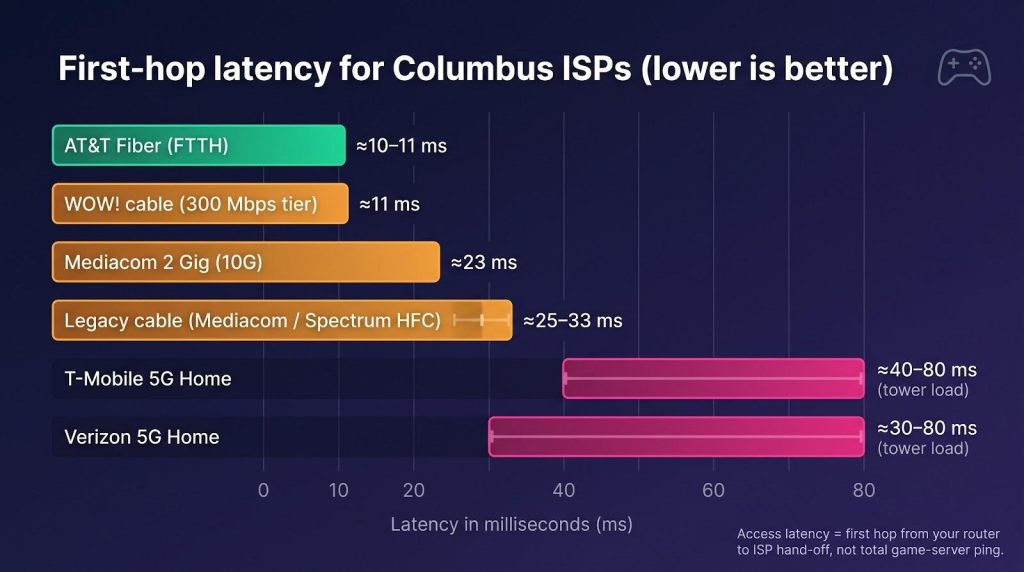
Fiber still rules. AT&T’s ≈10 ms first hop leaves the most headroom when the route to a game server adds another 20, 30, or 40 ms. WOW’s cable nodes measure around 21 ms residentially and uploads cap at 50 Mbps, which is fine for ranked play and video calls but not for streaming out at high bitrate. Mediacom’s new 10G platform cuts older cable latency by roughly one-third, yet still trails fiber by double-digit milliseconds.
Fixed-wireless latency swings with tower load. You might see a 35 ms lobby on Tuesday afternoon and 90 ms on Friday night when phones flood the sector. Always run a wired-Ethernet test during your provider’s trial period, then fire up your favorite shooter at 8 pm; peak time reveals the truth.
If competitive shooters dominate your evenings, choose fiber first, the lowest-latency cable node second, and fixed wireless only when wired lines are unavailable.
Price comparison: what each provider costs over three years
Ads shout “just $30 a month,” yet the bill that counts is the total 36-month spend after promos end and one-time fees land on your card. The table below shows what five Columbus providers really cost if you order online, enable AutoPay, skip optional Wi-Fi upgrades, and live inside city limits (local taxes not included).
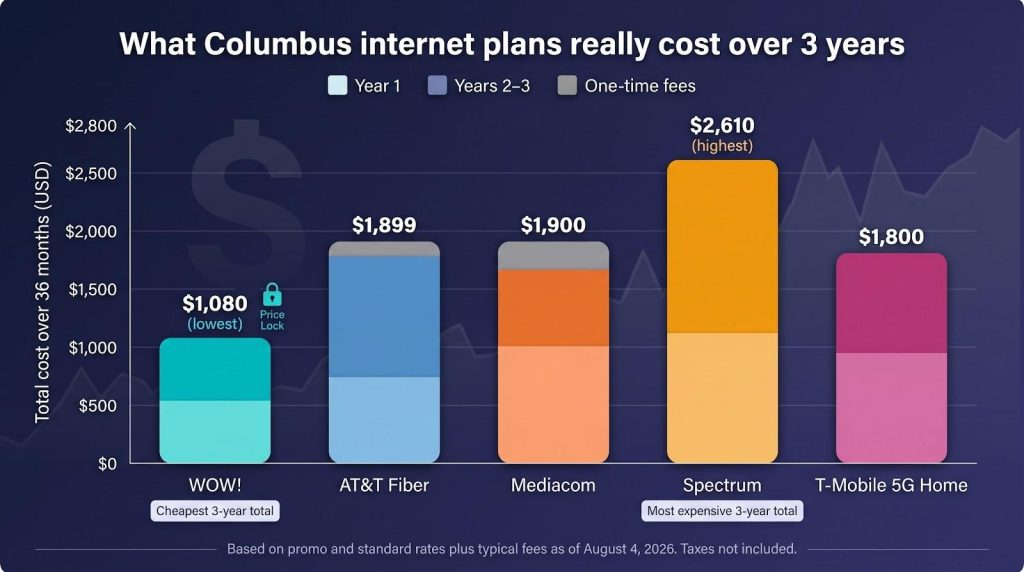
| Provider | Plan used for calc | Promo months | Promo rate | Standard rate | Typical up-front fees* | 3-year total |
| WOW! | 300 Mbps + Price Lock | 1–36 (Price Lock) | $30 promo | $45 published lock rate | $0 self-install | $1,620 |
| AT&T Fiber | 300 Mbps | 1–12 | $35 | $60 | $99 install | $1,899 |
| Mediacom | 1 Gbps | 1–36 | $50 | $50 | $75 install + $25 activation | $1,900 |
| Spectrum | 1 Gbps | 1–12 | $60 | $105 | $0 online self-install | $2,610 |
| T-Mobile 5G Home | Single tier | 1–36 | $50 | $50 | $0 self-install† | $1,800 |
*Published fees as of August 4, 2026 with online order and AutoPay discount applied.
†A one-time $35 device connection charge is due at sale.
WOW! is still the cheapest three-year hold on this list. It advertises Internet 300 from $25 a month in Columbus and sells Price Lock for Life as a $5 add-on, and its published Price Lock rate for that tier is $45 a month, which is what the three-year figure above uses. Confirm at checkout which of the two you are being locked into before you sign, because that single question is worth several hundred dollars over three years. Spectrum’s tempting $60 intro becomes the steepest bill once its Gig tier rises to $105. Mediacom’s three-year lock shows how a longer promo can match AT&T’s lower year-one price.
In short: lock long-term pricing whenever possible, and always add installation, activation, and equipment charges before calling a deal the cheapest.
Data caps, cloud gaming, and 4K streaming
Current data-policy snapshot (August 4, 2026)
| Provider | Advertised cap policy | Fine print worth knowing | Source |
| WOW! | Unlimited | Network-management clause lets WOW! throttle “extreme” users during congestion; no fee. | WOW! network disclosure (2026) |
| AT&T Fiber | Unlimited | No soft cap or throttling language in the current Broadband Facts label. | AT&T performance disclosure |
| Mediacom | Unlimited downstream | Uploading more than 1 TB in a month can cut upstream speed by 50 percent until the next bill. | Mediacom broadband disclosure |
| Spectrum | Unlimited | States no caps or overages, and reserves the right to manage traffic during unusual congestion. | Spectrum broadband disclosure |
| T-Mobile 5G Home | No overage fee | Traffic is deprioritized behind mobile phones; gateway terms note a possible review above roughly 1 TB per day. | T-Mobile Home FAQ |
All five services let you binge-stream, play across devices, game in the cloud, and pull huge patches without a hard stop. The only household likely to feel a squeeze is a pro creator on Mediacom who uploads more than a terabyte of footage each month, or a fixed-wireless user when the tower fills up at night.
Wi-Fi, security, and parental controls compared
| Provider | Included gateway / mesh | Wi-Fi spec | Security and parental controls | Monthly fee notes* | Source |
| WOW! | Standard cable gateway (included) | Wi-Fi 6 | Whole-Home WiFi mesh available; eero Secure and eero Plus add filtering and app controls as paid options | Whole-Home WiFi $9.99/mo, additional device $5.99/mo; eero Secure $3/mo, eero Plus $10/mo | WOW! rate card |
| AT&T Fiber | All-Fi gateway | Wi-Fi 6 | ActiveArmor network security and device manager | All-Fi Pro Wi-Fi 7 mesh included on 2 Gig and 5 Gig; $25 per month on lower tiers | AT&T Broadband Facts label |
| Mediacom | eero 6 (300 Mb), eero 7 (Gig and 2 Gig) | Wi-Fi 6 / Wi-Fi 7 | Total Defense antivirus and parental controls free 12 months, then $6 per month | Hardware included; Total Defense renews after year one | Mediacom plan sheet |
| Spectrum | DOCSIS modem plus Advanced Wi-Fi | Wi-Fi 7 | AI-based threat blocking and device pauses | $10 per month on ≤500 Mb; free on Gig | Spectrum Broadband Label |
| T-Mobile 5G Home | 5G gateway | Wi-Fi 6 | Basic firewall and content-filter toggles; no detailed schedules | No extra fee; add your own mesh if needed | T-Mobile FAQ |
*Fees current as of August 4, 2026 with AutoPay enabled.
A fast pipe matters only if the in-home Wi-Fi keeps up and blocks threats. WOW! keeps costs low but leases whole-home mesh and sells eero security as monthly add-ons. AT&T ships a solid Wi-Fi 6 unit and includes Wi-Fi 7 mesh on multi-gig tiers. Mediacom now bundles eero 7 on Gig and above, though its Total Defense suite begins billing after the first year. Spectrum offers a Wi-Fi 7 gateway for a $10 monthly fee on lower tiers, or free on Gig. T-Mobile’s 5G gateway is easy to place yet lacks granular schedules, so larger homes may want a third-party mesh.
Spending an extra five or ten dollars each month on built-in mesh and threat blocking often beats chasing separate gear later, especially if you manage dozens of smart-home devices.
Installation and customer-support comparison
| Provider | Self-install? | Typical pro-install fee* | Average setup time | Post-install support highlights |
| WOW! | Yes (coax tap live) | $99 truck roll if needed | About 10 min DIY | U.S. phone, chat, and most speed tickets close the same day |
| AT&T Fiber | No for new drops; yes for existing ONT | Up to $99 (often waived on 1 Gig+) | 3–4 hr tech visit | Smart Home Manager app handles reboots, channel scans, and callback scheduling |
| Mediacom | Yes on most tiers | $75 install + $25 activation | 20–30 min DIY | eero app resolves Wi-Fi issues; chat queue is faster than phone |
| Spectrum | Yes (Express Connect kit) | $0 online DIY; about $49 follow-up truck roll | 15 min DIY | Phone, chat, Twitter, and local store swaps (Macon Rd store praised) |
| T-Mobile 5G | Always DIY | $0 install; $35 device connection charge due at sale | 15 min gateway alignment | In-app chat shows tower stats; network issues resolve at tower cadence |
*Published fees as of August 4, 2026 with online order and AutoPay enabled; local promos may waive listed amounts.
Wired installs require more patience upfront, especially fresh AT&T Fiber drops, yet they usually deliver higher long-term uptime and quicker fault isolation. Fixed wireless wins on convenience: plug in the gateway, align for signal, and go. Decide which pain point matters more for your household: an afternoon off work today, or the chance of troubleshooting tower congestion later.
Internet availability by Columbus ZIP code (sample address checks, August 4, 2026)
| ZIP | Wired highlights | Fixed-wireless notes | Source |
| 31901 (Downtown / Uptown) | AT&T Fiber reached 6 of 10 sampled single-family addresses west of the river; older brick apartments relied on WOW! or Spectrum | Strong T-Mobile signal, yet evening tower congestion near the RiverCenter | FCC BDC and provider checkers |
| 31903 (Fort Benning) | WOW! cable served 9 of 10 base houses; AT&T Fiber limited to new on-post housing | Tower load during large training rotations slows both T-Mobile and Verizon | Address tests and InMyArea |
| 31904 (North Columbus) | New subdivisions off Whitesville Rd showed AT&T Fiber plus Mediacom 2 Gig; cul-de-sacs a mile away had only WOW! 300 Mb | Fixed-wireless fallback works where fresh builds lack coax | Provider checkers |
| 31906 (East Highland / Benning Hills) | Spectrum covered 8 of 10 sampled blocks; fiber scarce | Verify Mediacom 10G node upgrades if you rely on uploads | FCC map and Spectrum label |
| 31907 (Carver Heights / East Columbus) | Most competitive ZIP: overlapping WOW!, Mediacom, Spectrum, plus sizable AT&T Fiber islands | Use competition to negotiate promos, and verify post-promo rates | Address tests |
| 31909 (Midland / Nankipooh) | Rapid growth leaves some brand-new streets dark for wired service, while others already host new AT&T Fiber | T-Mobile and Verizon fill gaps until construction finishes | FCC BDC and provider checkers |
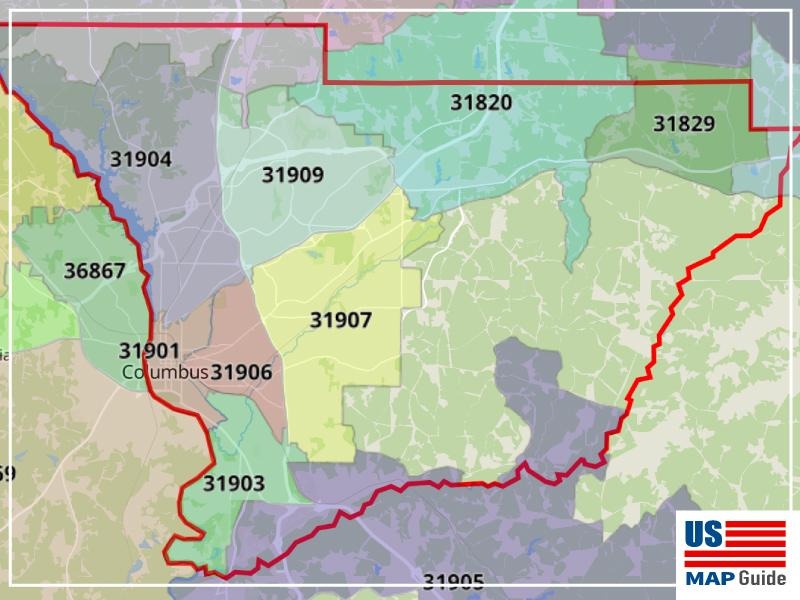
Columbus GA ZIP code internet availability map
Treat these patterns as hints, not gospel. Two houses on the same cul-de-sac can land on different coax nodes, or even different cell towers, which produces very different speed and latency. Always enter your exact address into the FCC map and each provider’s checker before you schedule an install; that five-minute lookup can save hours of hold music after move-in day.
Internet trends that could shake up the 2027 rankings
- T-Mobile Fiber rollout: Local residents have logged symmetrical 1–2 Gbps speed tests on freshly installed pink fiber, yet T-Mobile has not released a Columbus coverage map or Broadband Facts label as of August 4, 2026. If an official checker appears and the carrier honors its founder-rate promise, T-Mobile could leap ahead of Mediacom and challenge AT&T on latency and uploads.
- Mediacom DOCSIS 4.0 / 10G upgrade: A June 2026 press release states that higher-upload nodes will reach “additional Columbus neighborhoods through 2027.” When upstreams climb into the hundreds of Mbps across the city, cable will narrow the everyday gap with fiber, especially for creators who value upload speed more than single-digit ping.
- Georgia BEAD grants: The state’s Broadband, Equity, Access, and Deployment plan sets aside funding for the last underserved pockets of Muscogee County. New fiber builds on the northern edge of Columbus could add a surprise provider or extend an existing co-op’s footprint. Track official BEAD awards and local permit filings for updates.
We will rerun speed tests, refresh pricing, and update this guide as soon as these changes reach real addresses.
Conclusion: check the address, then choose by use case
First, enter your exact address in the FCC map and every provider’s checker; two minutes now can prevent contract regret later.
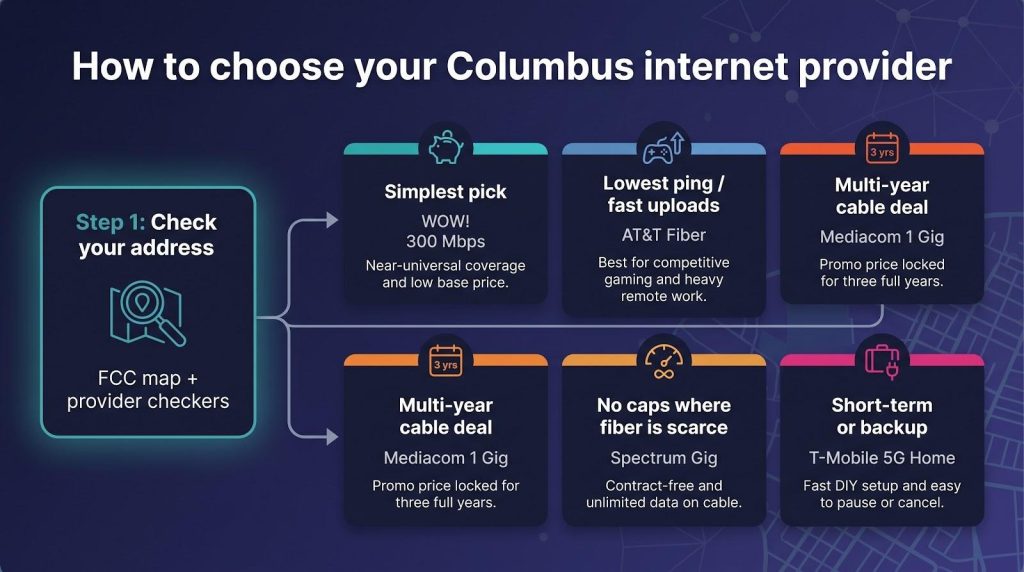
- Want the simplest pick? Choose WOW! 300 Mbps for near-universal coverage and an entry price from $25, with a paid Price Lock add-on if you want the rate held.
- Need the lowest ping or fast uploads? AT&T Fiber wins every address it reaches.
- Looking for a multi-year cable bargain? Mediacom 1 Gig stays $50 for three full years.
- Fiber scarce but no caps required? Spectrum Gig fills the gap, though you should budget for the year-two jump.
- Short-term lease or backup line? T-Mobile 5G Home sets up in minutes and bills month to month.
Whatever you order, use the free trial window: run a wired speed test, fire up an online match at 8 pm, and stream a 4K movie at the same time. Real-world stress tests beat any marketing sheet. Happy surfing, Columbus.